
Operating a professional body art studio requires meticulous attention to legal compliance, especially when serving clients under 18. A properly structured piercing consent form for minors protects your business from liability exposure while ensuring you meet state and local regulatory standards. The documentation requirements vary significantly across jurisdictions, and failing to implement compliant protocols can result in license revocation, substantial fines, and civil lawsuits. Understanding these requirements is not optional-it is a core operational necessity for every studio owner.
Legal Framework for Minor Consent Documentation
State regulations governing body art services for minors differ dramatically across the United States. Most jurisdictions prohibit certain piercings entirely for clients under 18, while others permit specific procedures with proper parental consent and documentation. As a studio owner, you must understand your specific state's requirements before accepting any minor client.
The age threshold represents the first critical consideration. Understanding California's piercing laws demonstrates how some states set absolute age minimums for specific procedures, regardless of parental consent. Surface piercings, dermal anchors, and genital piercings typically remain prohibited for all minors in most jurisdictions.
Documentation Requirements by State
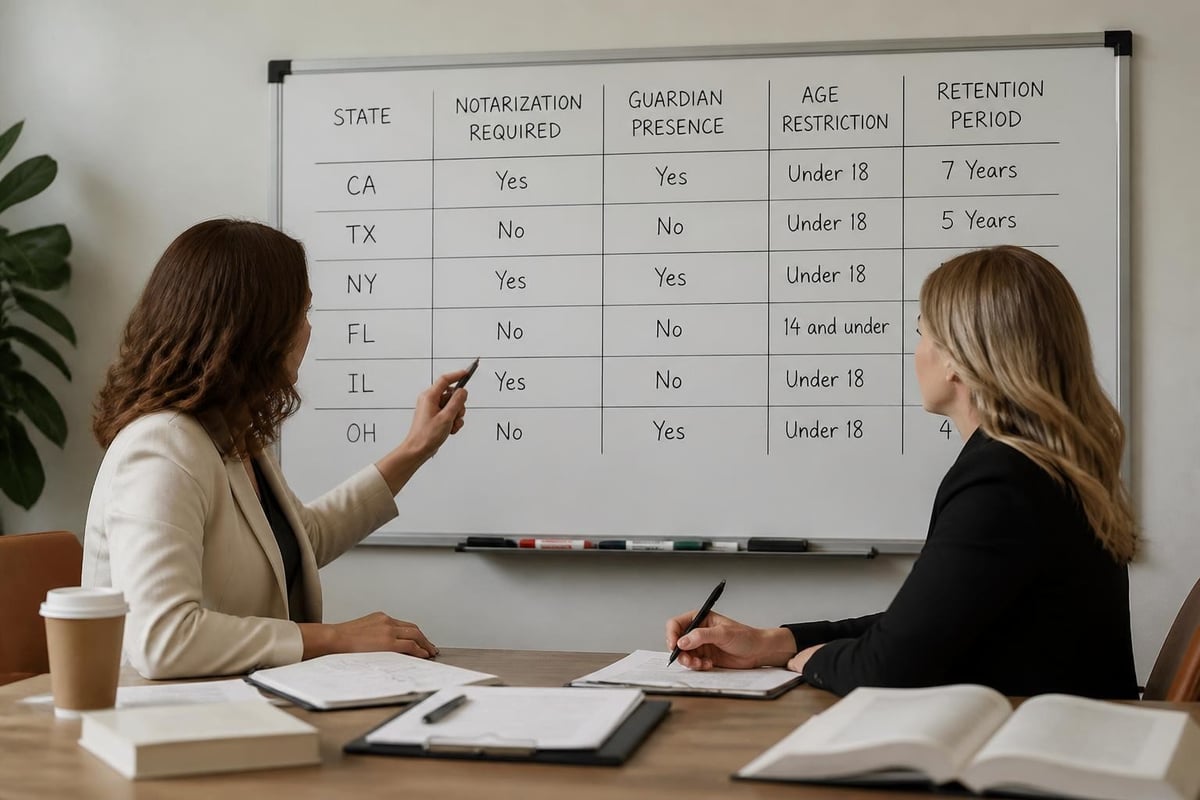
Different states mandate varying levels of documentation rigor. Some require simple written consent, while others demand notarized forms with specific language and witness signatures.
Common documentation elements include:
- Parent or legal guardian signature with date
- Government-issued photo identification verification for both minor and guardian
- Specific piercing location and procedure description
- Medical history disclosure sections
- Aftercare instruction acknowledgment
- Studio liability limitation clauses
Florida exemplifies strict standards, requiring notarized consent forms and mandating that studios maintain these records for specific retention periods. Oklahoma's administrative code establishes detailed consent form requirements that specify mandatory form sections and information disclosures.
Building a Compliant Piercing Consent Form for Minors
Your studio's minor consent form must serve dual purposes: legal protection and clear communication. The document should eliminate ambiguity while capturing all necessary authorizations and acknowledgments. Generic templates often fail to address jurisdiction-specific requirements or your studio's particular risk factors.
Start with client identification sections. Require the minor's full legal name, date of birth, and current address. The parent or legal guardian section must capture the same information plus relationship verification. Many studios fail this critical step by accepting consent from unauthorized adults-stepparents, older siblings, or grandparents without legal custody lack authority to provide consent.
Essential Form Components
The piercing consent form for minors should clearly document the specific procedure being authorized. Vague language like "ear piercing" creates disputes-specify the exact location (e.g., "single helix piercing on left ear using 16-gauge internally threaded titanium jewelry").
- Identification and Authorization Section: Full legal names, birthdates, addresses, relationship verification, and government ID numbers
- Procedure Description: Exact piercing location, gauge size, jewelry material, and quantity of piercings
- Medical Disclosure: Allergies, bleeding disorders, medications, existing health conditions, pregnancy status
- Risk Acknowledgment: Infection, scarring, rejection, migration, nerve damage, and keloid formation warnings
- Aftercare Commitment: Detailed cleaning protocols, jewelry handling restrictions, and follow-up requirements
- Studio Policies: No refund terms, minimum age enforcement, removal of non-compliant jewelry policies
The medical history section deserves particular attention. Certain conditions dramatically increase piercing risks for minors, including bleeding disorders, diabetes, compromised immune systems, and keloid-prone skin. Your form must capture this information comprehensively.
| Form Section | Legal Purpose | Business Protection |
|---|---|---|
| Parent ID Verification | Confirms legal authority to consent | Prevents unauthorized consent claims |
| Medical Disclosure | Identifies contraindications | Reduces adverse outcome liability |
| Procedure Specifics | Documents exact service authorized | Eliminates scope-of-service disputes |
| Risk Acknowledgment | Demonstrates informed consent | Counters negligence allegations |
| Aftercare Instructions | Transfers post-procedure responsibility | Limits infection liability |
Guardian Presence and Identification Protocols
Requiring physical guardian presence during both consultation and procedure represents best practice, even when not legally mandated. This protocol prevents forged signatures and ensures genuine informed consent. Parental consent requirements extend beyond signature collection-verification and documentation prove crucial during health department inspections and legal disputes.
Your front desk staff must verify identification for both minor and guardian. Acceptable documents typically include state-issued driver's licenses, passports, or government ID cards. Document the ID numbers, expiration dates, and issuing jurisdictions on the consent form itself. Photocopying these IDs provides additional verification but may trigger privacy compliance concerns-check your state's data protection regulations.
Handling Non-Standard Guardian Situations
Divorced parents, foster care arrangements, and legal guardianships create documentation challenges. The consent-providing adult must demonstrate legal authority through custody papers, guardianship orders, or power of attorney documents. Accepting consent from an unauthorized adult exposes your studio to significant liability.
When a minor presents with someone claiming guardian status, verify the relationship through documentation before proceeding. Many studios implement a 24-hour waiting period for first-time minor clients, allowing time to confirm guardian credentials and review medical disclosures thoroughly.
Red flags requiring additional verification:
- Guardian appears significantly younger than typical parent age
- Minor and guardian have different surnames without explanation
- Guardian lacks government-issued identification
- Minor expresses uncertainty about guardian's authority
- Documentation appears altered or photocopied poorly

Digital Transformation of Minor Consent Forms
Paper-based consent systems create operational inefficiencies and legal vulnerabilities for body art studios. Lost forms, illegible handwriting, incomplete sections, and damaged documents frequently emerge as problems during health department inspections or liability claims. The transition to digital consent management streamlines operations while improving compliance.
Digital platforms designed specifically for body art studios address industry-specific requirements that generic e-signature tools miss. A specialized piercing consent form system ensures you capture all necessary information while maintaining secure, searchable records. When working with minor clients, digital systems enforce completion of all mandatory fields before submission, eliminating the partial forms that plague paper systems.
Cloud storage provides permanent, disaster-proof archiving. Consider a scenario where a former minor client returns years later claiming improper consent procedures. Digital systems timestamp every signature, log IP addresses, and preserve complete form versions indefinitely. These metadata trails provide powerful evidence during disputes.
Implementation Considerations
Transitioning from paper to digital consent requires staff training and client education. Some guardians initially express skepticism about electronic signatures' legal validity. Federal and state e-signature laws, including the ESIGN Act and UETA, establish that electronic signatures carry identical legal weight to handwritten signatures when properly implemented.
Your digital consent system must accommodate in-studio form completion. Tablets at your front desk allow guardians and minors to review and sign forms while present at your location. The system should email completed forms automatically to both the studio and the guardian's email address, creating redundant copies.
Mobile-first form design proves essential for the modern studio workflow. Many guardians prefer reviewing consent forms at home before the appointment, reducing wait times and improving informed decision-making. Pre-appointment digital forms also allow your staff to identify medical contraindications or missing information before the client arrives.
Age-Specific Restrictions and Studio Policies
Beyond parental consent requirements, state laws establish age thresholds for different piercing types. Your studio policies should exceed minimum legal requirements to reduce risk exposure. Many successful studios implement internal age minimums above statutory requirements.
For example, while a state might permit navel piercings at age 14 with consent, your studio might establish a 16-year minimum based on healing complications and aftercare compliance concerns observed with younger clients. Document these policies clearly in your studio handbook and staff training materials.
Creating Tiered Age Policies
Implementing age-based service tiers provides clarity for staff and clients while demonstrating professional standards to health departments and insurance carriers.
| Age Range | Permitted Piercings | Additional Requirements |
|---|---|---|
| Under 13 | Earlobes only (specific gauge limits) | Guardian presence mandatory, extended aftercare review |
| 13-15 | Earlobes, nostril, select cartilage | Guardian presence mandatory, 48-hour consultation period |
| 16-17 | Most facial and ear piercings | Guardian presence recommended, detailed risk discussion |
| 18+ | All permitted piercings | Standard adult consent procedures |
The legal considerations for 16-year-olds seeking piercings illustrate how studios must balance client demand with risk management. Surface piercings, dermal anchors, and intimate piercings typically remain prohibited for all minors regardless of consent, and many professional studios extend these restrictions to clients under 21.
Your studio's written policies protect against discrimination claims when refusing service. A minor denied a surface piercing cannot claim unfair treatment when your established, documented policies prohibit that service for all clients under your age threshold.
Enforcement Consequences and Compliance Verification
Health departments conduct unannounced inspections of body art facilities, and consent form compliance represents a primary inspection focus. Inspectors review both your form templates and completed client files, verifying that you capture required information and maintain proper records.
Penalties for non-compliant minor body art services range from warning citations to immediate license suspension. Repeat violations or egregious cases-such as performing prohibited piercings on very young minors-can result in permanent license revocation and criminal charges.
Record Retention Requirements
Most jurisdictions mandate minimum retention periods for minor consent forms, typically ranging from three to seven years. Some states require indefinite retention for minors, reasoning that liability claims may not emerge until the client reaches adulthood.
Implementing a systematic record retention protocol prevents accidental destruction of required documents. Digital systems eliminate physical storage concerns while ensuring compliance with retention mandates. Tag minor consent forms distinctly in your database to prevent premature deletion during routine archiving procedures.
Retention best practices include:
- Store all minor forms separately from adult client records
- Implement automatic retention flags preventing deletion before mandatory period expires
- Maintain redundant backups in geographically separate locations
- Document your retention policy in writing and train all staff
- Review retention compliance quarterly as part of operational audits

Staff Training and Quality Control
Your staff's understanding of minor consent requirements directly impacts your compliance posture. Every team member who interacts with clients-from front desk personnel to practicing piercers-must understand verification protocols, documentation requirements, and your studio's specific policies.
Develop written training materials covering state-specific regulations, your studio's enhanced requirements, and red flag identification. Understanding Ohio's specific requirements demonstrates how jurisdiction-specific knowledge prevents violations. Conduct quarterly training refreshers to reinforce protocols and address new regulatory developments.
Role-playing exercises help staff navigate difficult scenarios. Practice situations where a minor arrives with an adult who cannot produce custody documentation, where medical disclosures reveal contraindications, or where the requested piercing violates your age-based policies. These exercises build confidence and consistency in applying your protocols.
Documentation Quality Audits
Implement monthly audits of completed consent forms to identify documentation gaps before health department inspections discover them. Review a random sample of minor client files, checking for complete signatures, properly documented ID verification, specific procedure descriptions, and thorough medical disclosures.
When audits reveal incomplete forms or staff cutting procedural corners, immediate corrective action prevents pattern establishment. Additional training, revised protocols, or personnel changes may prove necessary to maintain compliance standards.
Create a quality control checklist for staff to use during every minor client interaction:
- Government-issued photo ID examined for both minor and guardian
- ID numbers and expiration dates recorded on consent form
- Legal relationship to minor verified and documented
- All medical history sections completed without blanks
- Specific piercing location and jewelry specifications documented
- Risk acknowledgment section initialed and dated
- Guardian and minor signatures obtained with witnesses
- Digital copy emailed to guardian's verified email address
Managing Challenging Consent Scenarios
Real-world situations frequently deviate from ideal consent scenarios. Divorced parents may disagree about piercing authorization, minors may present expired identification, or guardians may struggle with English-language forms. Your protocols must address these situations consistently.
When only one divorced parent provides consent, verify that they possess legal authority through custody documentation. Some custody agreements grant sole medical decision-making authority to one parent, while others require joint consent for non-emergency procedures. Without documentation confirming authority, refusing service protects your studio from disputes between parents.
Language barriers require careful handling. Consent forms must be genuinely understood, not just signed. Provide forms in multiple languages for your service area's demographics, or work with qualified interpreters to ensure comprehension. Having a minor translate the form for their own parent fails to demonstrate informed consent.
Emergency Contact and Medical Release Components
Minor consent forms should capture emergency contact information beyond the consenting guardian. If a medical emergency occurs during or immediately after the procedure, having alternative contacts and medical release authorization proves crucial. Include specific authorization for emergency medical treatment and ambulance transport if the guardian cannot be immediately reached.
This section should document the minor's primary care physician, known allergies, current medications, and any relevant medical conditions. During medical emergencies, this information helps first responders provide appropriate treatment quickly.
Technology Integration for Compliance Management
Modern body art studios operate within complex compliance frameworks requiring systematic documentation approaches. Manual paper systems cannot reliably track consent form completion, flag missing information, or provide rapid retrieval during inspections.
A piercing consent form for minors implemented through specialized digital platforms offers automated compliance checking. The system can require guardian email verification, prevent form submission until all mandatory fields are completed, and automatically archive forms with tamper-proof timestamps. These features substantially reduce the compliance burden on busy studio staff.
Integration with your booking system creates seamless workflows. When a guardian schedules an appointment for a minor, the system automatically sends the appropriate consent form for advance review and completion. The form flags the minor status, triggering age-appropriate templates with enhanced documentation requirements.
Analytics capabilities help studio owners identify compliance trends. Review data showing what percentage of minor appointments complete consent forms before arriving, which staff members have the highest incomplete form rates, or how often medical disclosures reveal contraindications requiring procedure cancellation.
Implementing compliant documentation for minor clients protects your studio's license, reduces liability exposure, and demonstrates professional standards that distinguish your business in a competitive market. Moving from paper-based processes to purpose-built digital systems eliminates documentation gaps while improving client experience and operational efficiency. InkWaiver provides specialized digital consent forms designed specifically for tattoo and piercing studios, allowing minor clients and their guardians to complete legally compliant forms on their phones before appointments. The platform sets up in two minutes, captures all required information automatically, and stores forms securely in the cloud for easy retrieval during inspections or disputes.