
Operating a piercing studio requires navigating complex legal requirements, especially when working with minor clients. A properly executed piercing minor consent form protects your business from liability, ensures regulatory compliance, and establishes clear documentation of parental authorization. Understanding the specific requirements in your jurisdiction and implementing a reliable consent process is fundamental to professional studio operations in 2026.
Understanding Legal Requirements for Minor Piercing Consent
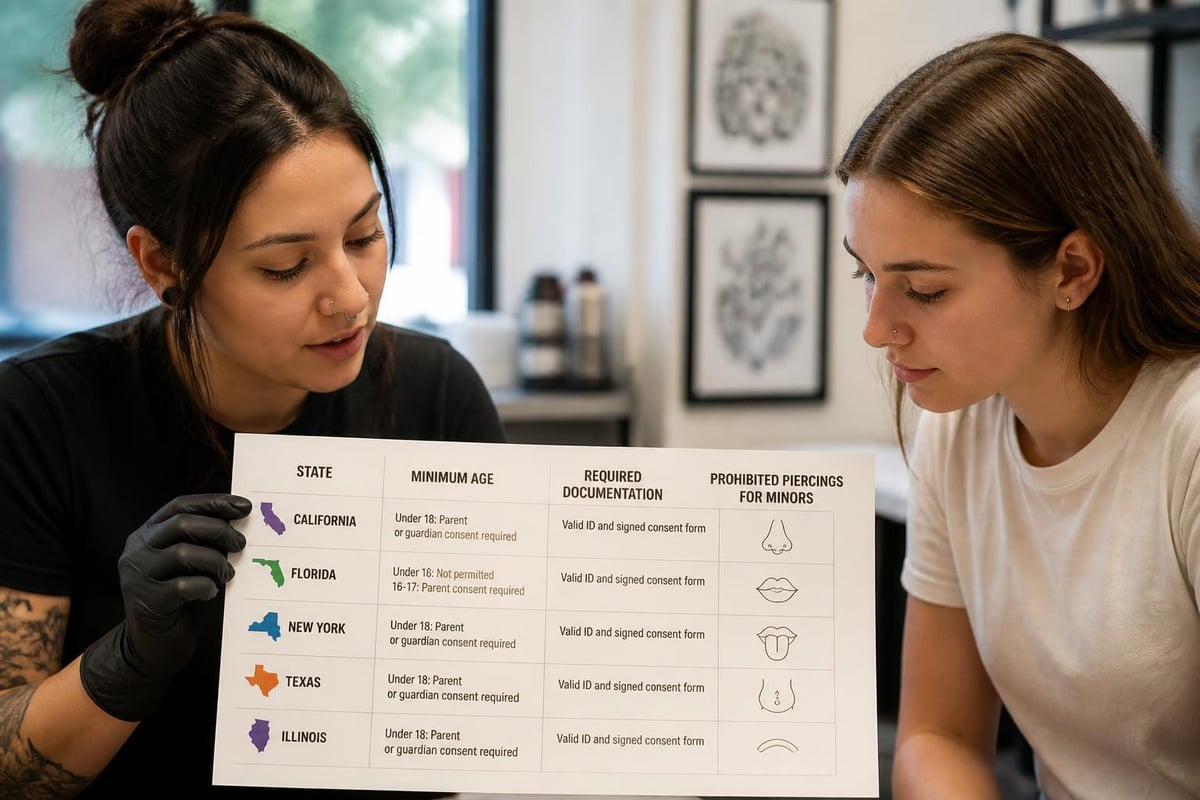
State and local regulations governing body piercing for minors vary significantly across the United States. While some jurisdictions permit ear piercings for young children with parental consent, others impose strict age minimums and documentation requirements for all body modifications.
Oklahoma's administrative code requires specific information on consent forms, including client identification, procedure details, and acknowledgment of risks. Your studio must verify that forms meet or exceed minimum state requirements.
Common Age Restrictions Across Jurisdictions
Most states establish three-tier age categories for body piercing:
- Under 14 years: Typically limited to earlobes only, requiring parent or legal guardian presence
- 14-17 years: May permit additional piercings with notarized consent and identification
- 18 years and older: No parental involvement required
Some jurisdictions prohibit certain piercings entirely for minors, regardless of parental consent. Wisconsin's piercing laws exemplify this approach, restricting specific body modifications until clients reach legal adulthood.
Essential Components of a Valid Piercing Minor Consent Form
A legally compliant piercing minor consent form must contain specific elements to withstand scrutiny during health department inspections or potential legal disputes. Missing even one required component can invalidate the entire document.
Required Information Fields
Your consent form should capture the following data points:
- Minor's full legal name and date of birth
- Parent or legal guardian's full legal name
- Government-issued identification numbers for both parties
- Specific piercing location and jewelry type
- Date and time of procedure
- Studio name, address, and license number
- Piercer's name and license number
Beyond basic identification, the form must include comprehensive disclosures about risks, aftercare requirements, and potential complications. Florida's requirements mandate notarization for minor consent forms, adding an additional verification layer that protects both the studio and the client.
Risk Acknowledgment and Medical Disclosure Sections
The consent document must clearly outline potential risks including infection, allergic reactions, keloid formation, nerve damage, and scarring. Parents must acknowledge these risks in writing before you proceed with the piercing.
Include a medical disclosure section that asks about:
- Current medications and supplements
- Known allergies (especially to metals)
- Blood disorders or clotting conditions
- Diabetes or immune system conditions
- Recent vaccinations or illnesses
- History of keloid scarring
This information protects your license and reduces liability exposure if complications arise post-procedure.
Documentation and Verification Protocols
Establishing rigorous verification protocols prevents fraudulent consent and protects your studio from serious legal consequences. Studios have faced criminal charges when piercers failed to properly verify parental authority.
Acceptable Identification Documents
Both the minor and the accompanying adult must present government-issued identification. Acceptable documents include:
| Minor's ID Options | Parent/Guardian ID Options |
|---|---|
| Birth certificate | Driver's license |
| Passport | State ID card |
| School ID with photo | Passport |
| Learner's permit | Military ID |
The parent's identification must match the name on the minor's birth certificate or custody documentation. If names don't match, request certified court documents establishing guardianship or custody rights.
South Dakota's regulations specify that consent forms must be obtained before performing body piercings on minors, emphasizing the importance of proper documentation timing.
Verifying Parental Authority
Not every adult claiming to be a parent has legal authority to consent. Situations requiring additional documentation include:
- Step-parents: Need custody documentation or legal guardianship papers
- Grandparents: Require guardianship orders unless they have formal custody
- Foster parents: Must present current foster care placement documents
- Adoptive parents: Should provide adoption decree if surnames differ
Keep photocopies of all identification and supporting documents with the signed consent form. These records prove due diligence if questions arise later.

Notarization Requirements and Alternatives
Some states mandate notarization for piercing minor consent forms, creating logistical challenges for studios. Understanding when notarization is required and how to streamline the process improves your booking workflow.
States Requiring Notarized Consent
Florida stands out for its strict notarization requirements. According to detailed information on Florida's minor consent forms, both the parent's signature and the minor's consent require notarization by a certified notary public.
This creates several operational considerations:
- Maintaining an on-site notary or notary relationship
- Allowing clients to obtain notarization before appointments
- Building extra time into the booking process
- Charging notary fees or absorbing the cost
Studios without in-house notary services should establish relationships with nearby notaries who can accommodate walk-in appointments on short notice.
Digital Alternatives and Electronic Consent
Where state law permits, digital consent solutions offer significant advantages over paper forms. Modern platforms allow parents to complete and sign piercing minor consent forms remotely before the appointment, streamlining your intake process.
Digital consent systems like InkWaiver enable clients to fill out forms on their phones, creating timestamped, cloud-stored records that are more secure than paper documents. This approach reduces lost forms, eliminates storage issues, and provides immediate access during health department inspections.
However, verify that your jurisdiction accepts electronic signatures for minor consent. Some states require wet signatures or notarization that cannot be completed digitally.
Creating Station-Level Compliance Workflows
Every piercer in your studio must follow identical consent procedures regardless of experience level. Inconsistent practices create liability gaps and increase violation risk during inspections.
Pre-Procedure Checklist for Minor Clients
Implement a mandatory checklist that piercers must complete before performing any minor piercing:
- Verify client is accompanied by parent/legal guardian
- Check government-issued ID for both parties
- Confirm name matching between minor's birth certificate and parent's ID
- Review medical disclosure section for contraindications
- Obtain parent signature on consent form
- Obtain minor's signature on consent form
- Verify all required fields are completed
- Make copies of identification documents
- Assign unique form number and file appropriately
Train apprentices and new piercers extensively on verification protocols. A single mistake can result in criminal charges, license suspension, or civil liability.
Handling Non-Standard Situations
Develop clear policies for challenging scenarios:
Divorced parents: Only the custodial parent or a parent with joint legal custody can provide consent. Request custody documentation if there's any uncertainty.
Emergency contacts: Older siblings, friends, or other relatives cannot consent unless they have court-ordered guardianship.
Out-of-state clients: Apply your state's requirements, not the client's home state rules. Some studios refuse minor clients from other states to avoid jurisdictional complications.
Emancipated minors: Require court documentation of emancipation. The emancipation order replaces parental consent.
Record Retention and Storage Best Practices
Signed piercing minor consent forms become critical evidence if disputes, infections, or complications occur. Proper storage and retention policies protect your business during legal discovery or licensing investigations.
Minimum Retention Periods
Most states don't specify retention periods for body art consent forms, so apply general medical record standards. The statute of limitations for personal injury claims typically runs 2-3 years, but minors can file claims for several years after reaching age 18.
Recommended retention schedule:
- Keep all minor consent forms for minimum of 7 years from procedure date
- For clients who were 17 at time of piercing, retain until they turn 25
- Store in secure, organized filing system with easy retrieval
- Maintain digital backups if using paper forms
This conservative approach ensures records remain available if a client files a claim years after the original procedure.
Physical vs. Digital Storage Solutions
Paper forms create ongoing storage challenges. A busy studio performing 20 minor piercings monthly generates 240 forms annually, requiring substantial filing space within 5-7 years.
| Storage Method | Advantages | Disadvantages |
|---|---|---|
| Physical filing | No technology required | Requires physical space |
| Familiar process | Vulnerable to damage/loss | |
| Easy to verify signatures | Difficult to search/retrieve | |
| Digital scanning | Space efficient | Requires initial investment |
| Searchable database | Needs backup protocols | |
| Multiple access points | Technology dependence | |
| Cloud-based platform | Automatic backups | Ongoing subscription cost |
| Remote access | Requires internet connection | |
| Integrated workflows | Initial learning curve |
Texas piercing studios that handle significant minor client volume increasingly adopt digital solutions to manage record-keeping requirements efficiently.

Training Staff on Minor Consent Procedures
Your compliance is only as strong as your least-trained piercer. Regular training sessions reinforce proper procedures and keep staff updated on regulatory changes.
Initial Onboarding Requirements
New piercers should complete comprehensive training covering:
- State-specific age restrictions and requirements
- Proper identification verification techniques
- Recognition of fraudulent documents
- Handling difficult parent-client interactions
- Documentation completion and filing protocols
- Privacy compliance (HIPAA considerations)
Use role-playing scenarios where trainers present challenging situations like mismatched identification, hostile parents, or unclear custody arrangements. This practice builds confidence and reduces errors during actual client interactions.
Ongoing Education and Updates
State regulations change periodically. Schedule quarterly compliance reviews covering:
- Recent regulatory updates or legislative changes
- Review of any consent-related incidents or near-misses
- Procedure refinements based on operational experience
- Inspection findings and corrective actions
Document all training sessions with sign-in sheets and training materials. This documentation proves due diligence if licensing boards investigate complaints.
Common Mistakes That Create Liability Exposure
Even experienced studios make preventable errors with piercing minor consent forms. Understanding these pitfalls helps you avoid expensive consequences.
Insufficient Parent Verification
Accepting the word of an accompanying adult without proper identification verification represents the most common and dangerous mistake. Studios have faced criminal charges when adults fraudulently posed as parents to authorize piercings.
Always verify identification and relationship documentation, even if you've seen the client before or the adult seems trustworthy. Develop a "trust but verify" culture where staff feel empowered to request additional documentation without management approval.
Incomplete Form Fields
Rushed consent processes often result in missing signatures, unchecked acknowledgment boxes, or blank medical disclosure sections. An incomplete form provides no legal protection and may violate state requirements.
Implement a final review step where piercers verify all required fields are completed before the client leaves the station. Missing information is nearly impossible to obtain after clients depart.
Misunderstanding Age Calculation
Some piercers calculate age based on the appointment date rather than the procedure date, creating documentation discrepancies. Others round ages ("almost 18") rather than requiring clients to wait for their actual birthday.
Use exact dates of birth and procedure dates to determine age. When a client is days away from their 18th birthday, schedule them after they reach legal adulthood rather than risk a violation.
Handling Parent Refusal and Difficult Situations
Not every parent requesting a minor piercing understands or agrees with your documentation requirements. Develop scripts and policies for managing these interactions professionally.
When Parents Challenge Requirements
Some parents object to identification requirements, medical questions, or notarization mandates. Prepare responses that emphasize legal compliance:
"I understand this seems like extra steps, but state law requires specific documentation for minor piercings. These requirements protect both your child and our business license. We can't proceed without proper documentation, regardless of the piercing type."
Never waive requirements to secure business. The financial penalty and license risk far exceed any single appointment's revenue.
Refusing Service Professionally
When documentation is insufficient or questionable, refuse service politely but firmly:
"I'm unable to verify the required parental authority based on the documentation provided. I recommend bringing [specific missing document] for a future appointment. Our studio prioritizes compliance with state regulations."
Document refusal incidents including date, client names, and reason for refusal. This record protects you if clients file complaints alleging discrimination or unfair treatment.
Integration With Overall Studio Compliance Programs
Piercing minor consent forms represent one component of comprehensive studio compliance. Integrate these processes with broader health, safety, and licensing requirements.
Health Department Inspection Preparedness
Inspectors frequently review minor consent documentation during routine inspections. Organize forms systematically so you can quickly locate any record by date or client name.
Create an inspection-ready binder containing:
- Sample completed piercing minor consent form
- Documentation of staff training on minor consent procedures
- Copies of state regulations applicable to your jurisdiction
- Standard operating procedures for age verification
- Record retention policy
This preparation demonstrates professionalism and regulatory awareness, often resulting in smoother inspections.
Linking Consent to Aftercare Documentation
Connect your consent process to aftercare instruction delivery. When clients sign consent forms acknowledging piercing risks, simultaneously provide written aftercare instructions they must also acknowledge receiving.
This creates a comprehensive documentation trail showing you properly informed clients about the procedure, associated risks, and necessary post-procedure care. Such thorough documentation significantly strengthens your position in dispute resolution.
Templates for piercing consent forms should integrate seamlessly with your studio's broader documentation workflow, creating efficiency while maintaining compliance.
Adapting Forms for Different Piercing Types
Not all piercings carry identical risks or require the same level of medical disclosure. Consider developing tiered consent forms based on piercing location and complexity.
Standard vs. Enhanced Consent Forms
Earlobe piercings carry relatively low risk compared to cartilage, oral, or genital piercings. Some studios use simplified forms for low-risk procedures and comprehensive versions for higher-risk work.
Standard form (earlobes, nostril):
- Basic medical disclosure
- Standard risk acknowledgment
- Standard aftercare
Enhanced form (cartilage, oral, surface):
- Detailed medical history
- Extended risk disclosures
- Specific aftercare requirements
- Additional contraindication screening
This approach ensures documentation matches the procedure's complexity and risk profile while avoiding unnecessary paperwork for simple piercings.
Jewelry-Specific Considerations
Different jewelry materials require different medical disclosures. Forms should specifically identify the jewelry material (surgical steel, titanium, gold, etc.) and ask about relevant allergies.
For minors receiving initial piercings, document that you recommended implant-grade materials and explain why cheaper alternatives increase complication risk. This protects you if parents later claim you didn't provide adequate guidance.
Digital Transformation and Modern Workflows
The body art industry is gradually transitioning from paper-based to digital documentation systems. Understanding available technologies helps you modernize operations while maintaining compliance.
Benefits of Digital Consent Systems
Digital platforms offer advantages beyond simple storage:
- Pre-appointment completion: Parents fill out forms before arriving, reducing station time
- Automatic field validation: Systems flag missing required information
- Instant backups: Cloud storage eliminates loss risk
- Easy retrieval: Search by name, date, or other criteria
- Remote access: Review forms from anywhere for appointment preparation
- Integration potential: Connect with scheduling, client management, and payment systems
Modern studios report significant time savings when clients complete minor piercing consent forms digitally before appointments.
Choosing the Right Platform
When evaluating digital consent solutions, prioritize:
- Legal compliance: Verify the system meets your state's signature and documentation requirements
- Data security: Ensure HIPAA-level encryption and privacy protections
- Ease of use: Clients should complete forms without assistance
- Mobile optimization: Most clients will use smartphones
- Support quality: Technical issues need rapid resolution
- Pricing structure: Understand per-form vs. subscription costs
Request demonstrations and trial periods to evaluate platforms with your actual workflows before committing to long-term contracts.
Special Considerations for Multi-Location Studios
Studios operating multiple locations face additional complexity ensuring consistent compliance across all sites. Standardization becomes critical when different cities or counties apply varying regulations.
Centralized vs. Localized Requirements
If your locations span multiple jurisdictions, determine whether each faces different requirements. Some considerations:
- Compile regulations for each location
- Identify the strictest requirements across all jurisdictions
- Apply the highest standard universally, or
- Maintain location-specific forms reflecting local rules
Universal application of the strictest standards simplifies training and reduces error risk, though it may require unnecessary steps in more permissive jurisdictions.
Compliance Auditing Across Locations
Implement regular audits reviewing consent form completion at each studio. Sample 10-15 recent minor consent forms per location quarterly, checking for:
- Complete required fields
- Proper identification documentation
- Appropriate medical disclosures
- Correct signatures
- Proper filing and retention
Document findings and require corrective action plans for locations showing deficiencies. This proactive approach identifies problems before they escalate to violations.
Staying Current With Regulatory Changes
Body art regulations evolve as legislators respond to industry incidents, public health concerns, and changing social attitudes. Maintaining current knowledge protects your business from inadvertent violations.
Monitoring Legislative and Regulatory Updates
Establish systems for tracking relevant changes:
- Subscribe to state health department newsletters
- Join professional body art associations
- Monitor industry publications and forums
- Attend annual licensing renewal seminars
- Consult with body art attorneys periodically
When regulations change, update forms immediately and retrain all staff before implementing new requirements. Document the training and form updates to demonstrate compliance efforts.
Building Relationships With Local Health Departments
Proactive communication with local health departments provides advance notice of upcoming changes and clarifies ambiguous requirements. Many health departments offer consultation services for regulated businesses.
Request periodic form reviews where inspectors verify your piercing minor consent form meets current requirements. This collaboration prevents violations and demonstrates good faith compliance efforts.
Understanding and implementing proper piercing minor consent form procedures protects your studio from liability while ensuring clients receive safe, professional service. The documentation requirements may seem burdensome, but they establish clear authorization and risk acknowledgment that safeguards everyone involved. For studios ready to modernize their consent processes, InkWaiver provides digital consent solutions specifically designed for body art professionals, allowing clients to complete required forms on their phones while creating secure, cloud-based records that streamline compliance and eliminate paper form headaches.