
Every piercing studio faces the same critical challenge: protecting your business while providing exceptional client experiences. A properly structured piercing permission form serves as your first line of defense against liability claims, ensures regulatory compliance, and establishes clear expectations with every customer who walks through your door. Whether you run a dedicated piercing studio or offer body modification services alongside tattoo work, understanding consent documentation is fundamental to professional operations. This comprehensive guide breaks down everything studio owners and professional piercers need to know about creating, implementing, and managing effective permission forms.
Essential Components of a Professional Piercing Permission Form
Your piercing permission form must capture specific information to meet both legal requirements and industry best practices. Missing even a single critical element can leave your studio exposed during health department inspections or legal disputes.
Client Identification and Contact Information
Start with comprehensive identification fields that verify who you're working with:
- Full legal name (matching government-issued identification)
- Date of birth and age verification
- Current physical address
- Mobile phone number and email address
- Emergency contact with relationship and phone number
This data serves dual purposes: confirming identity before the procedure and creating reliable records for follow-up communication. Many jurisdictions require studios to maintain client records for three to seven years, making accurate contact information essential for compliance.
Health Disclosure and Medical History
The medical screening section represents your most important risk management tool. Professional body piercing consent forms require clients to disclose conditions that might contraindicate the procedure or require special precautions.
Critical health screening questions include:
- Current medications (particularly blood thinners or immunosuppressants)
- Allergies to metals, latex, or topical antiseptics
- Blood-borne pathogen status (HIV, Hepatitis B/C)
- Diabetes or other conditions affecting healing
- Pregnancy or breastfeeding status
- Previous keloid formation or excessive scarring
- Recent illnesses, surgeries, or vaccinations
Structure these questions with clear yes/no checkboxes and follow-up fields for details. The format matters during health inspections, as ambiguous answers or missing responses can result in violations.

Legal Requirements Across Different Jurisdictions
Consent form regulations vary significantly depending on your location. Understanding jurisdiction-specific requirements protects your studio from compliance violations and potential closure.
United States Regulations
Most US states regulate body piercing through health departments rather than specialized boards. Requirements typically include:
| State Category | Minimum Age | Parental Consent | Record Retention |
|---|---|---|---|
| Strict regulation states | 18+ | Notarized for 16-17 | 7 years |
| Moderate regulation | 18+ | Parent present for minors | 5 years |
| Minimal regulation | Varies | Written consent sufficient | 3 years |
California, New York, and Florida impose particularly stringent documentation standards. California requires specific font sizes for disclosure statements, while New York mandates separate forms for different piercing categories. Always consult your local health department for exact specifications.
If you serve minors, implementing a dedicated piercing consent form for minors with enhanced parental verification becomes necessary. This typically requires government-issued ID from both the minor and parent, plus proof of relationship.
European Union and GDPR Compliance
EU-based studios face additional data protection obligations under GDPR. Your piercing permission form must include:
- Clear data processing justification
- Specific retention period disclosure
- Client rights to access, modify, or delete data
- Consent for marketing communications (separate from procedure consent)
- Information on data storage location and security measures
GDPR violations carry substantial penalties, making proper consent documentation critical for European operations. Many studios adopt digital solutions to automate compliance tracking and data management.
United Kingdom Post-Brexit Standards
UK regulations combine health and safety requirements with data protection under UK-GDPR. Local councils often impose additional licensing requirements beyond national standards. Check your specific borough or district requirements, as London boroughs frequently maintain stricter protocols than other regions.
Creating Effective Risk Acknowledgment Language
The acknowledgment section transforms your form from simple paperwork into a legal shield. This is where clients confirm their understanding of procedure risks, aftercare responsibilities, and studio policies.
Procedural Risk Disclosure
Professional studios provide clear, comprehensive risk information without using intimidating legal jargon. Your disclosure should address:
Immediate risks:
- Bleeding during and after the procedure
- Pain, swelling, and tenderness at the site
- Nerve damage (rare but possible with certain placements)
- Rejection or migration of jewelry
Healing complications:
- Infection requiring medical treatment
- Allergic reactions to jewelry materials or cleaning solutions
- Keloid or hypertrophic scarring
- Prolonged healing times (months for cartilage piercings)
Research on needle insertion mechanics demonstrates the physical factors affecting tissue trauma during piercing procedures. While academic, this understanding informs how you describe procedural risks to clients.
Aftercare Responsibility Transfer
Clearly state that proper healing depends on client aftercare compliance. This section should specify:
- Your studio provides verbal and written aftercare instructions
- Clients bear responsibility for following these instructions
- Failure to follow aftercare increases complication risk
- Clients must contact the studio immediately if problems develop
Many liability claims arise from aftercare non-compliance. Documenting that you provided proper instructions and the client acknowledged responsibility protects your business when complications occur.

Policy Acknowledgments and Client Obligations
Beyond medical and risk information, your piercing permission form should establish clear studio policies that prevent disputes and confusion.
Photography and Portfolio Usage
Most studios photograph their work for portfolios, social media, and marketing materials. Your form must obtain explicit permission:
- Can you photograph the piercing?
- May you use images on social media (specify platforms)?
- Is the client's face included, or piercing only?
- Can you use images in paid advertising?
Some jurisdictions require separate photography consent forms. Even where not legally required, separate releases provide clearer documentation and respect client privacy preferences.
Jewelry and Material Selection
Document the client's jewelry selection, including:
- Material composition (surgical steel, titanium, gold, etc.)
- Gauge and dimensions
- Whether the client was informed of premium material options
- Acknowledgment that jewelry changes during healing risk complications
This prevents disputes when clients claim they weren't offered higher-quality materials or didn't understand jewelry specifications.
Refund and Touch-Up Policies
Clearly state your policies on:
- No refunds after procedure completion
- Touch-up or correction policies if placement issues arise
- Timeline for requesting corrections (typically 48-72 hours)
- Additional fees for jewelry changes or size adjustments
Ambiguous refund policies create unnecessary disputes. Explicit documentation protects both parties.
Implementing Digital Consent Solutions
Paper forms create operational headaches: storage requirements, illegible handwriting, damaged documents, and time-consuming filing systems. Modern piercing studios increasingly adopt digital alternatives that streamline operations while improving compliance.
Benefits of Digital Permission Forms
Transitioning to digital consent management delivers immediate operational improvements:
- Instant accessibility: Retrieve any client's consent form in seconds from any device
- Automatic backups: Cloud storage eliminates lost or damaged forms
- Space savings: Reclaim valuable studio square footage from filing cabinets
- Enhanced legibility: No more struggling to read chicken-scratch handwriting
- Search functionality: Find specific clients or date ranges instantly
- Compliance automation: Track retention periods and purge expired records automatically
Studios report saving 10-15 hours monthly on form management after implementing digital systems. That time translates directly to additional billable appointments or improved client service.
Integration with Booking Workflows
The most effective digital solutions integrate consent forms directly into your booking process. Clients complete and sign their piercing permission form on their phones before arriving at the studio. This approach:
- Reduces wait times and improves client experience
- Ensures complete information before the appointment
- Flags contraindications early, preventing wasted appointments
- Captures signatures with legal validity
Systems like InkWaiver specifically designed for body modification studios allow clients to complete forms on their phones in under two minutes, with all data automatically stored in compliant cloud archives.
Special Considerations for Minor Consent Forms
Working with clients under 18 requires enhanced documentation protocols. Standard piercing permission forms don't provide adequate protection when serving minors.
Parental Verification Requirements
Most jurisdictions require in-person parental presence for minors seeking piercings. Your minor piercing consent form should document:
Parent/guardian verification:
- Government-issued photo ID for the parent
- Proof of relationship (birth certificate, custody papers, etc.)
- Parent's signature witnessed by studio staff
- Statement that parent was physically present during consultation
Minor client verification:
- Government-issued ID or school ID with photo
- Age confirmation matching parent-provided information
- Minor's signature (required even with parental consent)
Some states require notarization for minors between 16-17, even with parental consent. Check local requirements before establishing your minor consent protocols.
Age Restrictions by Piercing Type
Many studios implement internal policies restricting certain piercings based on age, even when legally permissible:
| Piercing Type | Typical Minimum Age | Common Restrictions |
|---|---|---|
| Earlobe | 5+ with parent | None |
| Cartilage (ear) | 13+ with parent | Some studios require 16+ |
| Nostril | 14+ with parent | Often 16+ studio policies |
| Navel | 16+ with parent | Many require 18+ |
| Nipple/genital | 18+ only | No exceptions |
Document age restrictions clearly on your consent forms to prevent disputes when you decline service to minors for specific piercing types.
Form Template Resources and Customization
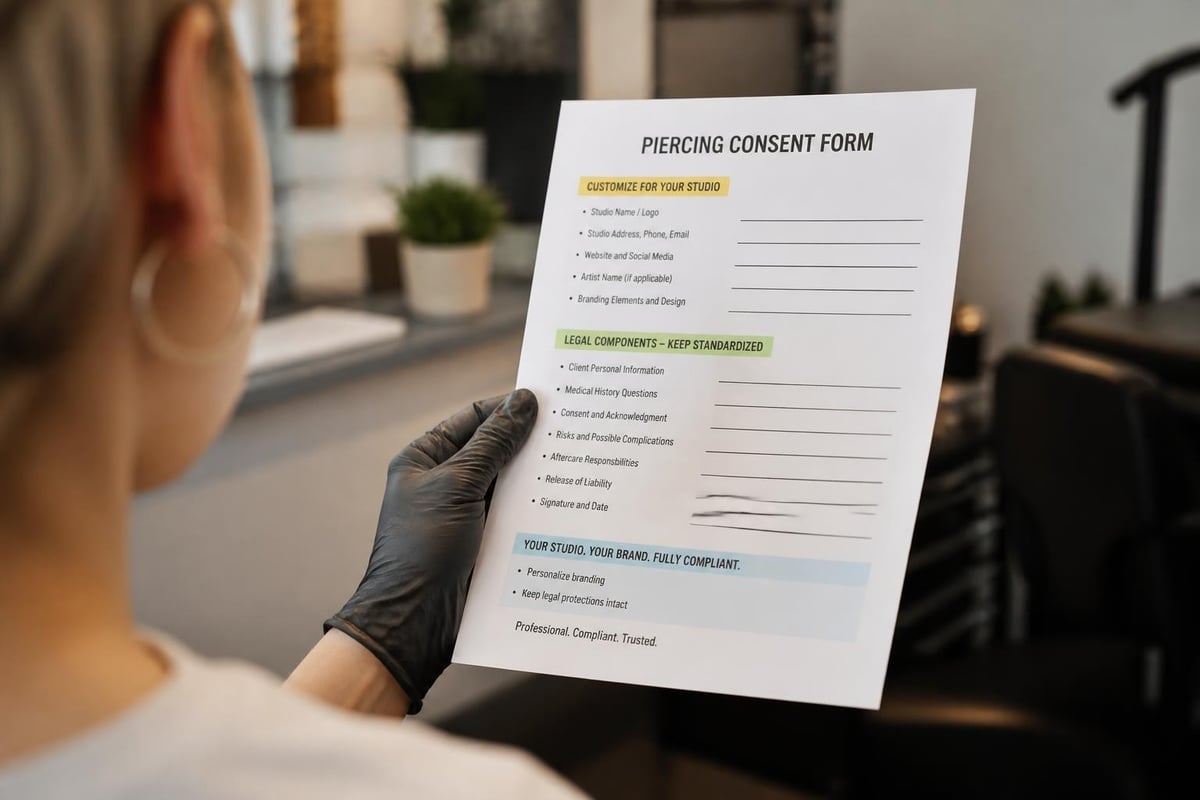
Starting with a professionally designed template ensures you include all necessary components while maintaining legal compliance. Several resources offer customizable templates specifically for piercing studios.
Professional Template Sources
Established template providers include comprehensive consent language reviewed by legal professionals:
- JotForm's piercing consent templates offer industry-standard fields with customization options for studio-specific policies
- 123FormBuilder's piercing forms provide digital signature functionality and mobile-responsive designs
- Specialized consent form builders focus specifically on body modification studios with health screening emphasis
Review multiple templates before selecting one. The best approach often involves combining elements from several sources to create a form perfectly matched to your studio's needs and local regulations.
Customization Best Practices
Template modification requires careful attention to legal and practical considerations:
Do customize:
- Studio name, contact information, and branding
- Specific jewelry materials and gauges you offer
- Your unique aftercare protocols and product recommendations
- Studio-specific policies on deposits, rescheduling, and corrections
Don't modify:
- Core legal language on liability limitations
- Standard medical screening questions
- Risk disclosure statements (unless adding studio-specific risks)
- Signature and date fields
When in doubt, consult an attorney familiar with body modification regulations in your jurisdiction. The cost of legal review typically ranges from $300-$800 but provides invaluable protection against costly errors.
Record Retention and Storage Protocols
Creating effective forms represents only half the compliance equation. Proper storage and retention protocols ensure you can produce documentation when needed during inspections or legal proceedings.
Retention Timeline Requirements
Different jurisdictions mandate varying retention periods for client consent documentation:
United States (varies by state):
- California: 7 years from last service date
- New York: 6 years from procedure date
- Florida: 5 years from procedure date
- Texas: 4 years from procedure date
European Union:
- Minimum as specified in national law (typically 3-5 years)
- Maximum under GDPR proportionality requirements
- Subject to client deletion requests (with medical record exceptions)
United Kingdom:
- Generally 3-5 years based on local council requirements
- Longer if client was a minor (often until age 25)
Implement automated retention tracking to flag forms approaching their purge date. Destroying records prematurely creates compliance violations, while retaining them excessively increases GDPR liability.
Secure Storage Standards
Whether using paper or digital systems, secure storage protects client privacy and ensures document integrity:
Paper storage requirements:
- Locked filing cabinets in restricted-access areas
- Climate control to prevent damage
- Fire-resistant storage for permanent records
- Limited staff access with logging systems
Digital storage requirements:
- Encrypted cloud storage or local servers
- Password-protected access with role-based permissions
- Automatic backup systems (minimum 3-2-1 backup rule)
- Audit trails showing who accessed which records
Health department inspectors frequently audit storage protocols. Demonstrating robust systems during routine inspections prevents violations and builds regulatory trust.
Training Staff on Consent Form Procedures
Even the most comprehensive piercing permission form fails if staff don't implement it correctly. Consistent training ensures every team member understands their documentation responsibilities.
Onboarding New Piercers and Front Desk Staff
Include consent form protocols in your standard onboarding process:
Week 1: Form review and purpose
- Review every field and its legal purpose
- Discuss common client questions about specific disclosures
- Practice identifying incomplete or problematic responses
Week 2: Role-playing scenarios
- Client claims they already completed forms at another location
- Parent arrives without ID for minor's piercing
- Client wants to skip medical questions to "save time"
- Form reveals contraindication requiring procedure postponement
Week 3: Supervised real-world implementation
- Shadow experienced staff during client check-in
- Complete forms under supervision
- Handle form-related questions with trainer backup
Regular refresher training prevents procedural drift. Quarterly reviews ensure staff remain current on any form updates or regulatory changes.
Common Implementation Mistakes
Even experienced studios make preventable consent form errors:
- Allowing clients to skip sections "because they seem healthy"
- Accepting digital photos of parent ID instead of physical presence
- Filing incomplete forms with plans to "get missing info later"
- Using outdated form versions after policy changes
- Failing to provide clients with copies of signed forms
Create a checklist system that front desk staff complete before any client reaches the piercing station. This prevents procedure delays when incomplete documentation is discovered mid-appointment.
Addressing Client Pushback and Questions
Some clients resist thorough consent documentation, viewing it as bureaucratic hassle. Professional responses maintain compliance while preserving positive client relationships.
Handling Common Objections
"I've been pierced here before; why do I need new forms?" Updated medical conditions, new risks, and regulatory requirements necessitate fresh documentation for each procedure. Explain that health status changes over time and consent cannot be assumed from previous visits.
"This seems like a lot of personal medical information." Emphasize that health screening protects their safety and healing outcomes. Compare it to medical forms required before surgical procedures, framing it as professional standard practice.
"Can I just sign without reading everything?" Politely insist clients read disclosures before signing. Some jurisdictions invalidate consent obtained through coercion or without adequate client understanding. Take time to highlight key sections and answer questions.
"I don't want to disclose my medical conditions." Explain that without accurate health information, you cannot safely perform the procedure. Offer to discuss concerns privately rather than at the front desk if privacy is the issue.
Explaining Digital Form Benefits
When transitioning from paper to digital systems, some clients express hesitation about electronic signatures or data storage. Address concerns proactively:
- Digital signatures carry the same legal validity as handwritten ones
- Cloud storage provides better security than paper filing cabinets
- Clients receive instant email copies for their records
- Environmental benefits align with conscious consumer values
Most resistance evaporates once clients experience the streamlined process. Digital forms completed on personal phones feel less invasive than clipboard paperwork in a waiting area.
Multilingual Consent Documentation
Studios in diverse communities face language accessibility requirements. Providing consent forms in clients' native languages demonstrates professionalism and may be legally required in some jurisdictions.
Language Requirement Regulations
United States: Title VI of the Civil Rights Act requires federally funded programs to provide language access, but private studios face no federal mandate. However, some states impose requirements:
- California: Businesses must provide translations if serving significant non-English populations
- New York City: Consumer contracts above certain thresholds require translation
- Many cities: Business license conditions include language access provisions
European Union: Language requirements vary by country, with some requiring contracts in the consumer's language regardless of business size.
Translation Best Practices
Professional legal translation costs $0.10-$0.25 per word but ensures accuracy in critical risk disclosures and legal language. Avoid relying on automated translation tools for consent forms, as mistranslations create liability exposure.
Prioritize languages based on your client demographics. Most multilingual studios offer forms in:
- English (primary)
- Spanish (high demand across most US regions)
- Mandarin or Cantonese (major metropolitan areas)
- Additional languages based on local population
Tools like AI-powered form generators can help create initial drafts, but always have native speakers review final versions before implementation.
Integration with Health Department Compliance
Your piercing permission form represents just one component of comprehensive health department compliance, but it's often the first document inspectors request during routine audits.
Inspection Preparation Using Consent Forms
Smart studios use consent documentation as evidence of broader compliance:
- Forms demonstrate client screening protocols
- Signature dates prove procedure timing and scheduling practices
- Medical disclosures show you decline high-risk clients appropriately
- Retention systems indicate organizational competence
Before scheduled inspections, audit a random sample of consent forms for completeness. Missing signatures, blank medical sections, or illegible entries signal broader operational problems to inspectors.
Cross-Contamination Protocol Documentation
While separate from consent forms, cross-contamination prevention protocols should reference your intake documentation. For example, forms noting latex allergies should trigger documented equipment changes and cleaning procedures.
Create systems that flag specific consent form responses requiring special procedures:
- Metal allergies → Document titanium jewelry selection
- Immune compromised status → Enhanced sterilization protocols
- Bleeding disorders → Additional bleeding control supplies prepared
This integration demonstrates that consent forms actively inform your safety protocols rather than serving as mere legal paperwork.
Form Evolution and Regular Updates
Regulations change, new risks emerge, and studio policies evolve. Your piercing permission form requires regular review and updates to maintain compliance and effectiveness.
Establishing Update Schedules
Implement a formal review calendar:
Quarterly reviews: Check for minor regulatory changes, updated contact information, or policy modifications Annual comprehensive audits: Complete form review including legal consultation if significant changes occurred Event-triggered updates: Immediate revision following regulatory changes, legal disputes, or insurance carrier recommendations
Version control becomes critical when updating forms. Date each version and maintain archives of previous iterations. During legal proceedings, courts may examine which form version a client signed, making historical records essential.
Communicating Changes to Clients
When implementing updated forms, existing clients who return for additional piercings need clear communication:
- Email notices explaining changes 30-60 days before implementation
- Signage in the studio during transition periods
- Staff training on explaining updates during check-in
- Grandfather clauses (if any) for clients mid-treatment
Example professional consent forms from established studios demonstrate how clear, comprehensive documentation evolves over time while maintaining legal compliance.
Implementing comprehensive piercing permission forms protects your studio legally while establishing professional standards that build client trust. Modern digital solutions eliminate the administrative burden of paper management while enhancing compliance through automated retention tracking and instant accessibility. InkWaiver offers piercing-specific digital consent forms that clients complete on their phones in under two minutes, with legally compliant cloud storage and seamless integration into your booking workflow. Start your free 14-day trial to experience how proper consent documentation strengthens your business without adding operational complexity.