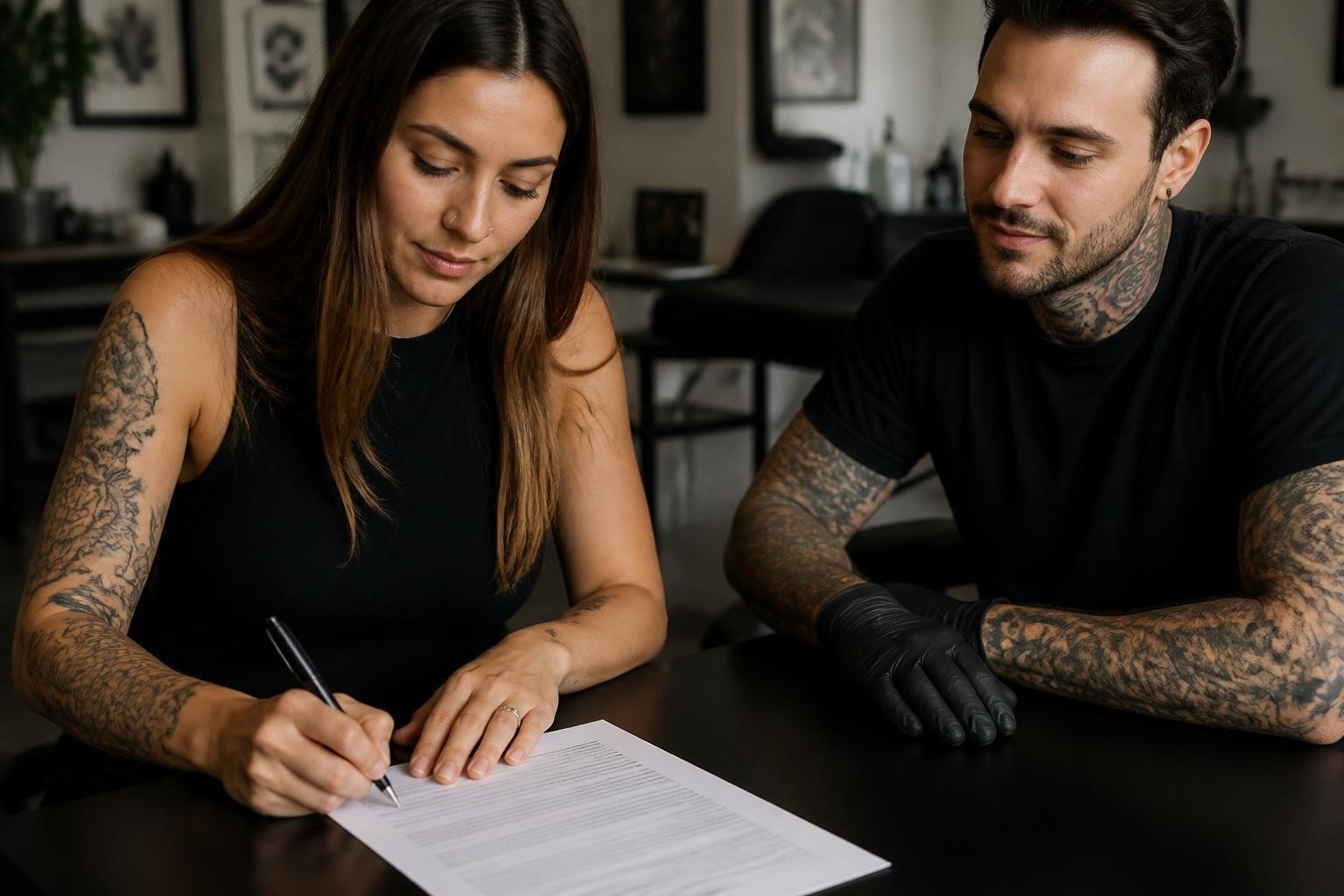
Running a professional tattoo studio requires more than artistic talent and technical skill. Every client who walks through your door represents potential liability exposure, which is why a comprehensive tattoo consent form template is one of your most important legal safeguards. This document protects your business from disputes, demonstrates professional standards during health department inspections, and ensures clients understand exactly what they're consenting to before you start working. Whether you operate a multi-artist studio or work as a solo artist, having standardized consent documentation is non-negotiable in 2026.
Essential Components of a Professional Tattoo Consent Form Template
A legally sound tattoo consent form template must capture specific information categories to provide meaningful protection. These aren't arbitrary sections-each serves a distinct legal and operational purpose.
Client Identification and Contact Information
Start with full legal name, current address, phone number, and email. Require a government-issued ID verification, noting the ID type and number. This creates an audit trail and helps prevent minors from using fake identification. Many shops photograph the ID alongside the consent form for additional documentation.
Date of birth verification is particularly critical. Even if someone appears obviously over 18, document their age. This protects you if questions arise later about minor consent procedures.
Health Screening and Medical History
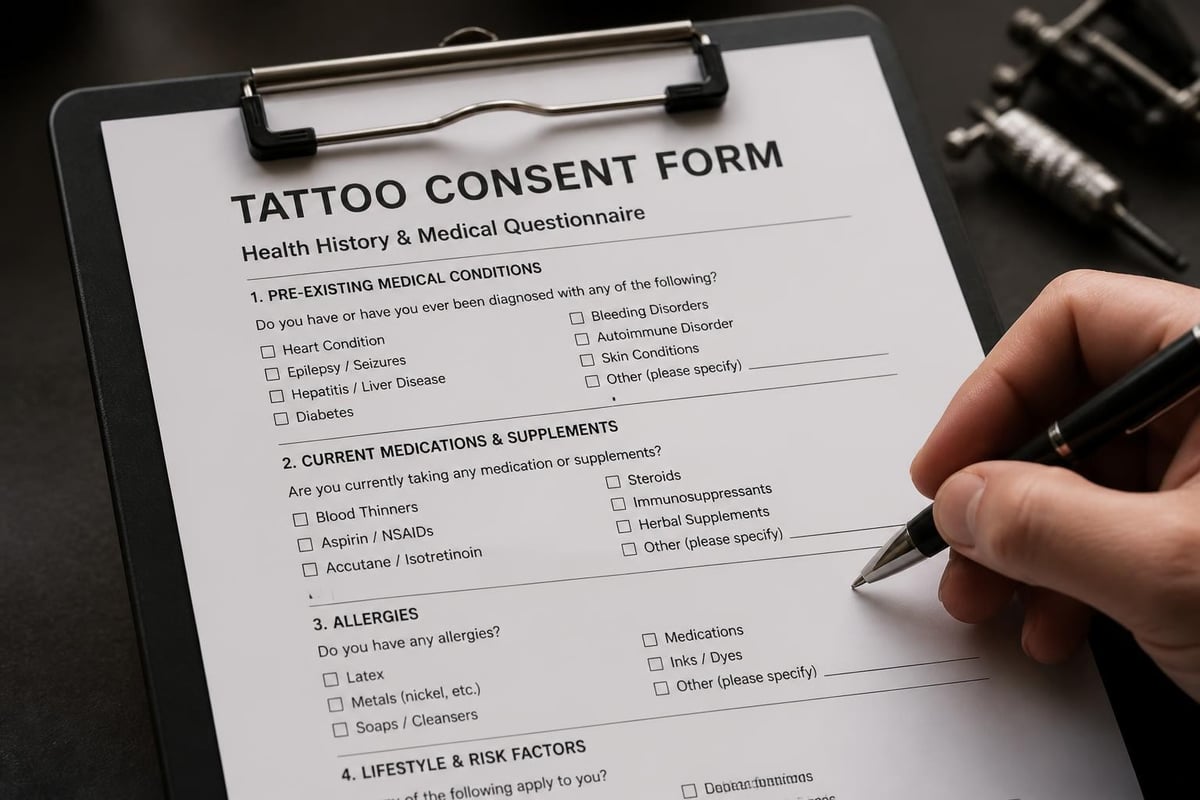
This section protects both you and your client. Include specific questions about:
- Blood-borne pathogen exposure (HIV, hepatitis B, hepatitis C)
- Current medications, particularly blood thinners
- Allergies to latex, metals, or anesthetics
- Skin conditions (eczema, psoriasis, keloid scarring tendency)
- Pregnancy or breastfeeding status
- Recent cosmetic procedures or surgeries
- Alcohol or drug consumption in the past 24 hours
Research on toxic metals in tattoo inks highlights why documenting known allergies is increasingly important. Frame questions clearly and require yes/no responses rather than open-ended answers that create ambiguity.
Design Confirmation and Placement Authorization
Document exactly what you're tattooing and where. Include fields for:
- Detailed design description or reference number to your flash sheets
- Body placement with anatomical specificity (not just "arm" but "outer right forearm, 3 inches below elbow")
- Size dimensions in inches
- Color specifications or note if black and gray work
- Custom design approval signature if applicable
This prevents disputes about what was agreed upon. Clients sometimes claim they requested different placement or sizing. Your free tattoo consent form template documentation eliminates this liability.
Legal Protection Elements Your Template Must Include
Beyond basic information collection, your tattoo consent form template needs specific legal language to hold up under scrutiny.
Informed Consent and Risk Acknowledgment
Clients must explicitly acknowledge they understand the risks involved. This section should detail:
Immediate Risks:
- Pain and discomfort during the procedure
- Bleeding and swelling
- Potential allergic reactions to ink or aftercare products
Long-term Considerations:
- Permanence of tattoos (removal is expensive, incomplete, and painful)
- Color fading over time, especially with sun exposure
- Possible scarring or keloid formation
- MRI complications from certain ink metals
- Employment or social discrimination
Use clear, accessible language. Legal jargon might seem more protective, but courts favor forms clients can reasonably understand. The tattoo consent form guide emphasizes that overly complex language can actually weaken your legal position.
Liability Waiver and Release of Claims
This section releases your studio from liability for outcomes the client has been informed about. Include language stating the client:
- Releases the artist and studio from claims related to the procedure
- Assumes all risks associated with getting tattooed
- Acknowledges they were given opportunity to ask questions
- Confirms they're of sound mind and not under influence
- Agrees the decision to get tattooed is voluntary
In the United States, these waivers are generally enforceable, though effectiveness varies by state. California and New York have different standards for liability releases than Texas or Florida. Consult a local attorney to ensure your specific language meets jurisdictional requirements.
Aftercare Acknowledgment
Document that you provided written aftercare instructions and the client agrees to follow them. This protects you when infections occur due to client negligence-swimming in lakes, exposing fresh tattoos to gym equipment, or ignoring cleaning protocols.
| Aftercare Element | Required Action | Timeline |
|---|---|---|
| Bandage removal | Remove initial wrap, wash gently | 2-4 hours |
| Cleaning frequency | Wash with antibacterial soap | 2-3 times daily for 2 weeks |
| Moisturizing | Apply thin layer fragrance-free lotion | 3-4 times daily for 3 weeks |
| Activity restrictions | Avoid swimming, sun exposure, tight clothing | 2-3 weeks minimum |
| Follow-up | Report signs of infection immediately | Throughout healing |
Digital vs. Paper: Modern Template Delivery Methods
The traditional clipboard-and-pen approach to consent forms creates operational headaches and legal vulnerabilities that many studio owners don't recognize until problems arise.
Problems with Paper Forms
Paper consent forms get damaged, lost, or become illegible over time. During health department inspections, you're required to produce records. Crumpled forms stored in boxes don't demonstrate professional compliance. Paper also creates storage challenges-California requires consent form retention for seven years, while other states mandate different timelines.
Cross-contamination is another concern. Pens and clipboards move between your work area and waiting room, potentially transferring pathogens. During 2020-2022, many studios finally acknowledged what infection control specialists had warned about for years.
Walk-ins complicate paper workflows. When you're setting up your station or midway through another client, stopping to photocopy someone's ID and file their consent disrupts your operation. Digital systems let clients complete forms on their phones before they arrive.
Digital Consent Form Advantages
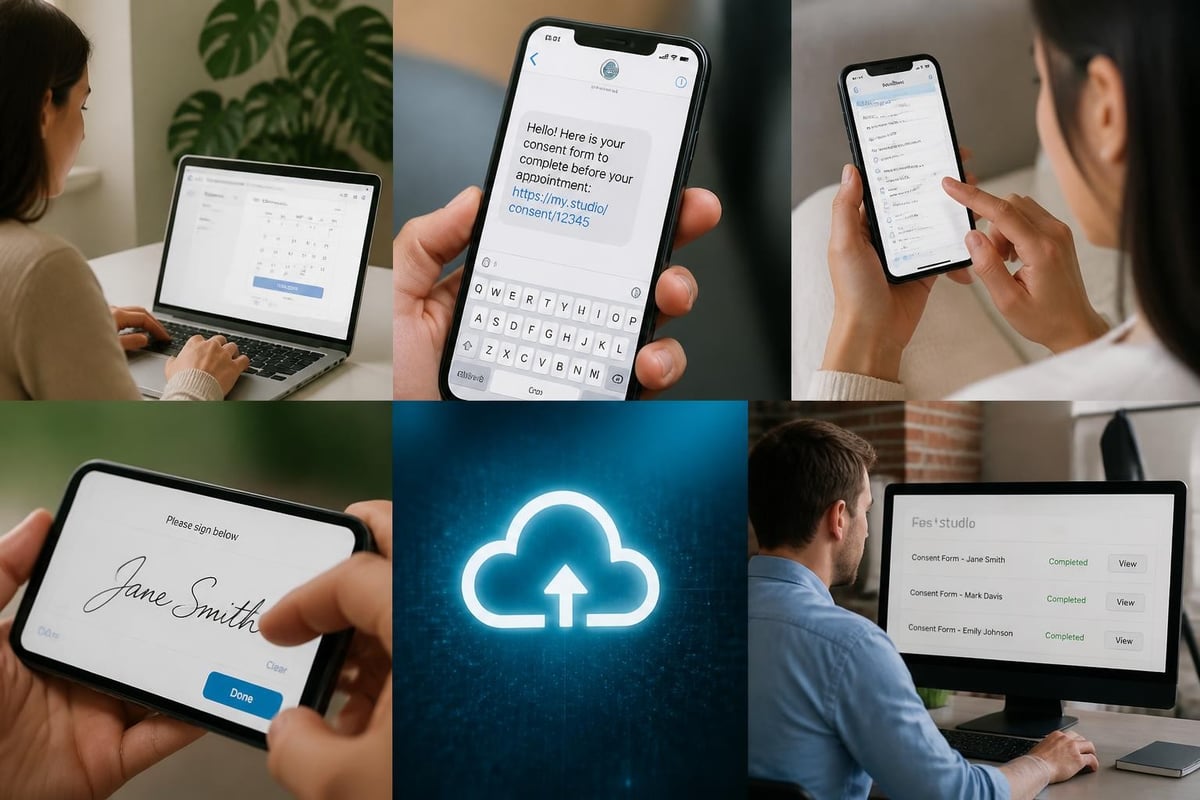
Modern tattoo studios are shifting to digital consent management for practical and legal reasons. Digital consent forms offer several advantages:
- Cloud storage: Never lose a form again; searchable archives retrievable in seconds
- Automatic timestamps: Legally verifiable signing time and date
- Remote completion: Clients fill forms on their phones before appointments
- Consistent formatting: Every form captures the same information clearly
- Easy updates: Modify your template once; all future forms use the updated version
- Reduced contact: Minimizes cross-contamination risks in your studio
Platforms like InkWaiver provide tattoo-specific digital forms that clients can complete on their phones before appointments, with e-signatures and GDPR-compliant cloud storage-eliminating paper entirely while maintaining legal compliance.
Customizing Your Template for Specific Situations
Not every client situation fits a standard template. Professional studios prepare variations for predictable scenarios.
Minor Consent Requirements
Tattooing minors is illegal in many US states, even with parental consent. However, jurisdictions that permit it require enhanced documentation. Your minor consent template needs:
- Parent or legal guardian identification verification (not just any adult)
- Notarized signatures in some states
- Explicit statement that the minor understands permanence
- Additional health screening (minors may not know their full medical history)
- Specific design restrictions (many jurisdictions prohibit face, neck, or hand tattoos on minors)
The tattoo consent form for minors requires specialized language and additional documentation beyond standard adult forms.
Cover-Up and Rework Consent
When covering existing tattoos or fixing another artist's work, add specific clauses:
- Acknowledgment that complete coverage may not be possible
- Color limitations based on existing ink
- Potential need for multiple sessions
- Photos of the original work attached to the consent
- Clear statement about realistic expectations
Clients often have unrealistic expectations about what cover-ups can achieve. Document these conversations explicitly.
Touch-Up and Warranty Terms
If you offer free touch-ups within a specific timeframe, spell out the terms:
- Touch-up window (typically 30-90 days after healing)
- Conditions that void the warranty (sun damage, picking at scabs, infection from poor aftercare)
- What's covered (normal fading, healing inconsistencies) versus what isn't (client design changes, additional elements)
- Requirement to follow aftercare instructions to qualify
This prevents misunderstandings when clients return six months later expecting free work.
State-Specific Considerations and Compliance
Tattoo regulations vary dramatically across jurisdictions. Your tattoo consent form template must reflect your specific location's requirements.
United States Variations
California: Requires explicit HIV/hepatitis disclosure language and mandates specific font sizes for certain warnings. Studios must retain consent forms for seven years and provide copies to clients upon request.
New York: Demands single-use needle confirmation and autoclave sterilization documentation. Some counties require additional health screening questions beyond state minimums.
Texas: Permits minors to receive tattoos with parental consent but requires notarized signatures and restricts locations (no visible tattoos above the collarbone).
Florida: Prohibits tattooing anyone under 18, even with parental permission. Violation results in automatic license suspension.
Check your state health department regulations annually. Requirements change, and ignorance provides no defense during inspections.
European Union Requirements
GDPR compliance adds layers to consent forms in EU jurisdictions. Your template must:
- Explicitly state how you'll store and use client data
- Provide clear opt-in (not opt-out) for marketing communications
- Explain data retention timelines
- Inform clients of their right to request data deletion (within legal retention limits)
- Identify your data protection officer if applicable
The legal requirements of consent forms under GDPR standards differ substantially from US approaches, particularly regarding data processing permissions.
United Kingdom Post-Brexit
While the UK maintained many GDPR principles through the UK GDPR, studios now follow UK-specific guidance from the Information Commissioner's Office. License requirements also vary between England, Scotland, Wales, and Northern Ireland.
Template Sources and Customization Resources
Finding a starting point for your tattoo consent form template doesn't require reinventing the wheel, but customization is essential.
Free Template Resources
Several platforms offer baseline templates:
- Zoho Forms provides customizable templates with conditional logic
- SurveyMonkey offers templates that simplify liability reduction
- Typeform delivers branded, professional formats
- Formplus includes online signature capabilities
The InkJin template covers all 50 US states and includes both PDF and Word formats for easy modification.
These templates provide structure, but generic forms miss jurisdiction-specific requirements. Use them as starting points, not final products.
When to Hire Legal Review
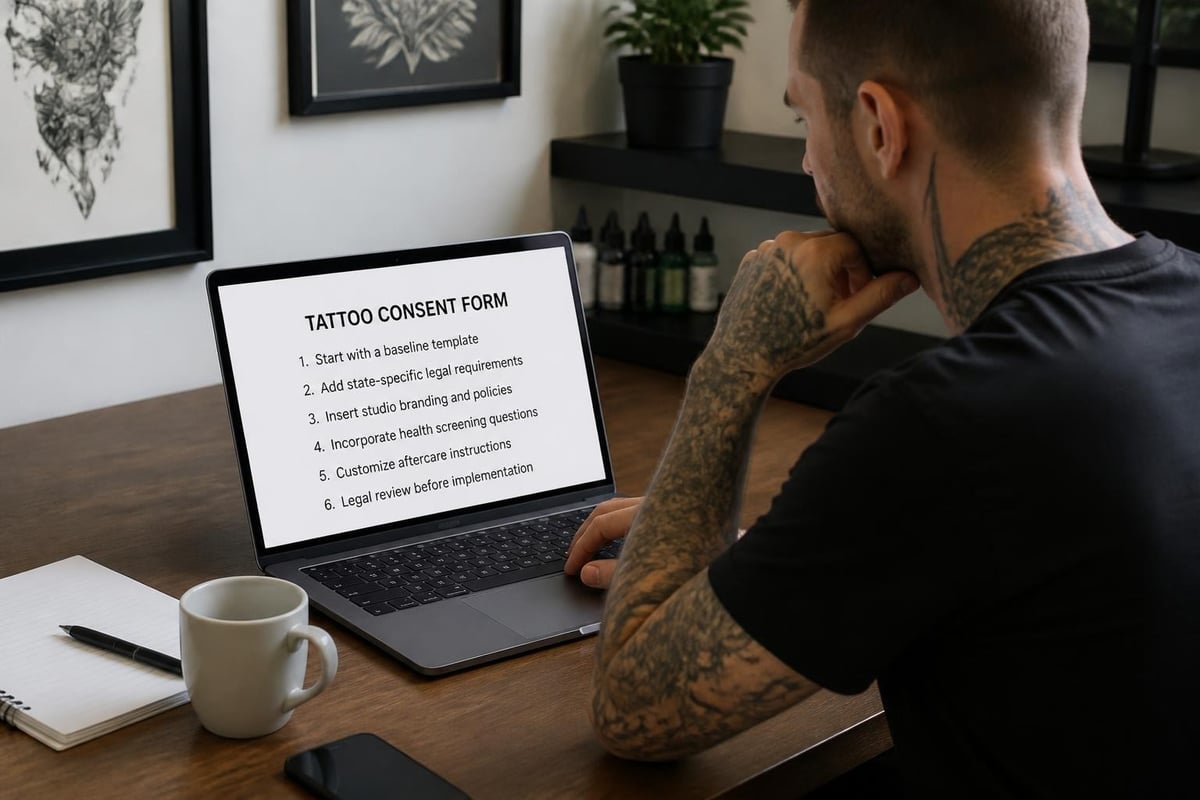
Invest in attorney review when:
- You're opening a new studio and establishing initial documentation
- You're expanding to multiple locations across state lines
- Your state updates tattoo regulations significantly
- You've had a legal dispute that revealed template weaknesses
- You offer specialized services (cosmetic tattooing, medical paramedical work, scarification)
Legal review costs between $500-$2,000 depending on complexity, but prevents six-figure lawsuits. Budget this as essential business insurance.
Common Mistakes That Weaken Your Consent Form
Even experienced studio owners make errors that compromise their legal protection.
Insufficient Client Verification
Accepting verbal confirmation of age or health status creates liability. Every statement needs documentation:
- Don't ask "Are you over 18?"-verify with government ID
- Don't ask "Any health conditions?"-list specific conditions requiring responses
- Don't accept crossed-out corrections-require new form completion
- Don't allow blank sections-every field needs completion or explicit "N/A"
Incomplete forms are nearly worthless in legal disputes. Courts view gaps as evidence you didn't properly inform the client.
Outdated Forms Still in Circulation
Update your template when regulations change, but ensure you're actually using the new version. Common scenario: You revise your template, save it to your computer, but the old version remains in the clipboard stack at your front desk. Six months later during an inspection, you discover half your recent clients signed outdated forms.
Solution: Date your templates prominently. Include a version number in the footer. Train staff to verify they're using current forms. With digital systems, updates automatically apply to all new forms.
Inadequate Signature and Witnessing
E-signatures are legally binding in all US states under the ESIGN Act (2000), but implementation matters. Digital signatures must:
- Identify the signer uniquely
- Record signing time and date automatically
- Prevent retroactive modification
- Store securely with access controls
For paper forms, require signatures in all critical sections-health acknowledgment, risk understanding, aftercare receipt, and final consent. A single signature at the end might not demonstrate the client read and understood each section.
Language Barriers Not Addressed
If you serve clients who don't speak fluent English, provide translations or use translation services during the consent process. A client signing a document they can't read hasn't given informed consent. Courts will side with the client in these disputes.
Maintain template versions in common languages in your area-Spanish in the Southwest US, Mandarin or Cantonese in urban areas with significant Chinese populations, Polish or Russian in certain Northeastern cities.
Integration with Your Studio Workflow
A tattoo consent form template only protects you if it's consistently used. Integration into your booking and appointment workflow ensures compliance.
Booking Flow Integration
Implement these steps:
- Consultation: Discuss design, placement, and pricing
- Appointment scheduling: Book the session with deposit
- Form delivery: Send consent form link 24-48 hours before appointment (digital) or ensure paper forms are available
- Pre-appointment completion: Client completes form before arriving
- Verification: Review completed form before starting work
- Storage: File immediately after session
This sequence prevents last-minute form completion while you're prepping your station or the client is anxious about starting.
Staff Training Requirements
Every artist and front desk staff member needs training on:
- Which template version to use for different scenarios
- How to verify form completion before work begins
- Where and how to store completed forms (physical or digital)
- What to do when clients refuse to answer specific questions
- How to handle corrections or updates during the appointment
Create a standard operating procedure document. New apprentices and guest artists should review this during onboarding.
Record Retention and Retrieval
Establish clear protocols:
Physical forms: File alphabetically or chronologically in locked cabinets. Separate by year for easier retrieval when retention periods expire.
Digital forms: Cloud-based systems with backup redundancy. Tag with client name, date, and artist for searchability.
Retention timeline: Follow your state requirements (typically 3-7 years). Calendar reminders for secure disposal when the retention period expires.
Access controls: Limit who can access consent forms. HIPAA doesn't apply to tattoo studios, but treating health information with similar confidentiality demonstrates professionalism.
Beyond Basic Consent: Additional Documentation
Comprehensive studios use consent forms as part of broader documentation systems.
Photo Documentation and Rights
Separate from the consent form, consider photo release forms for:
- Portfolio inclusion (website, social media, printed materials)
- Before/after documentation
- Process shots during the session
- Healing progress photos
Clients may consent to the tattoo but not want their body photographed. Don't assume permission. Some studios include photo rights within the main consent form; others use separate documents to ensure clarity.
Design Approval and Deposit Agreements
Custom work requires additional documentation:
- Sketch approval signatures before starting
- Deposit terms and refund policies
- Cancellation and rescheduling fees
- Design ownership rights (particularly for flash you create)
These typically exist as separate documents but reference the main consent form.
Waiver Forms for Special Circumstances
Certain situations require enhanced documentation beyond standard tattoo consent form templates:
- Working on scarred or compromised skin
- Tattooing over existing medical conditions
- Cosmetic tattoo procedures (permanent makeup, medical paramedical work)
- Laser tattoo removal if you offer that service
The free laser tattoo removal consent form addresses specific risks like hyperpigmentation and scarring that differ from application procedures.
A professionally designed tattoo consent form template protects your studio legally, demonstrates compliance during inspections, and establishes clear expectations with every client. Whether you choose paper or digital delivery, ensure your forms capture complete information, use clear language, and reflect your jurisdiction's specific requirements. InkWaiver eliminates paper consent forms entirely by letting clients complete legally compliant forms on their phones in under two minutes, with automatic cloud storage and e-signatures that hold up in court-so you can focus on creating exceptional tattoos instead of managing paperwork.